Your engagement surveys are dropping.
Your best people are checking out.
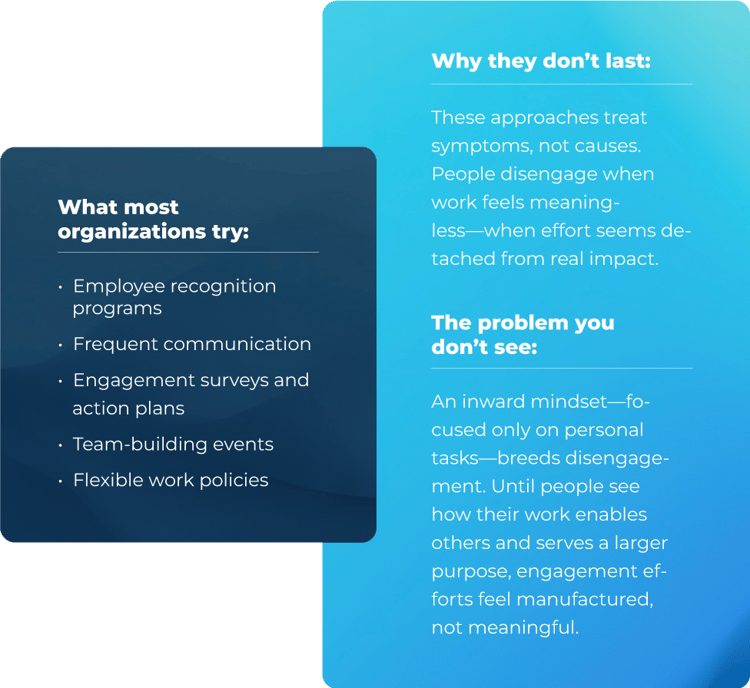
You've launched recognition programs, improved communication, and invested in perks. Engagement scores inch up temporarily, then slide back down. The problem isn't that people don't feel appreciated—it's that they don't feel their work matters.
When employees disengage, everything suffers
You see the warning signs everywhere. People showing up physically but checked out mentally. Here's what's actually happening:
Going Through the Motions
Employees do the minimum required but nothing more. They attend meetings without contributing. They complete tasks without caring about outcomes. Discretionary effort—the difference between adequate and excellent—disappears.
Silent Departure Before the Exit
Your best performers stop raising their hands for new projects. They disengage from team discussions. They're updating their resumes before you realize they're unhappy. By the time they give notice, they checked out months ago.
Cynicism Spreads
Disengagement is contagious. When engaged employees see others coasting without consequence, they question why they're working so hard. The culture shifts from "we're in this together" to "everyone for themselves."
The hidden cost: Research shows 90% of employees don't behave in ways aligned with cultural goals set by leadership. You can't impose engagement—it has to come from within.
You've tried boosting morale. Why is engagement still low?

Create engagement from the inside out
We don't try to make people feel engaged through programs and perks. We help employees shift from an inward mindset—where work is just tasks to complete—to an outward mindset where they see how their work impacts real people and contributes to collective success. When people understand their impact, engagement becomes natural, not manufactured.
Build Self-Awareness
Teams discover how their inward focus creates the very silos they complain about. When people see their role in the problem, they own their part in the solution.
Develop Accountable People
Using practical tools, teams learn to work toward each other instead of around each other. They identify how their decisions impact other departments and adjust accordingly.
Create Lasting Alignment
We help you embed collaboration into your systems, from how you run meetings to how you measure success—so the change sustains without constant intervention.
SUCCESS STORY: BUREAU OF PUBLIC DEBT
See what happens when engagement becomes real
"We realized the importance of this material in our culture. It was fundamental and foundational—laying the groundwork for widespread and coordinated success."
Commissioner | Bureau of Public Debt
What success looks like
Work Feels Meaningful
Employees stop seeing their jobs as disconnected tasks and start seeing how their work enables others to succeed. They understand their impact on teammates, customers, and organizational objectives. Engagement comes from within, not from external motivation.
Discretionary Effort Returns
People don't just do what's required—they look for ways to help. They contribute ideas in meetings. They step up for challenging projects. The difference between adequate and excellent performance reappears because people care about outcomes, not just completions.
Teams Support Each Other
When employees shift to an outward mindset, they naturally collaborate better. They help teammates who are struggling. They share knowledge freely. Competition for credit decreases while cooperation for success increases.
Retention Improves
Your best people stop quietly looking for exits because they feel connected to meaningful work. They see how they matter. New hires catch the culture and become engaged from day one because the entire system reinforces it.
Frequently asked questions
-
How is this different from employee engagement programs?
Engagement programs try to make people feel valued through recognition, communication, and perks. We address why people feel disconnected in the first place—they can't see how their work impacts anything meaningful. When people shift to an outward mindset, engagement becomes intrinsic, not dependent on external programs.
-
Do we have to change our entire culture?
You're not changing culture from the outside in—you're enabling people to shift their mindset, which naturally changes how they engage with work. Many organizations start with specific teams or departments and expand as results become visible.
-
How long before we see engagement improve?
Most organizations see measurable improvements in how people show up to work within 90 days. One medical supplier saw 65% productivity increase within six months with no staffing changes. A multi-national retailer saw 400% increase in sales performance. When engagement is real—not manufactured—results follow quickly.
Ready to restore real engagement?
Organizations across healthcare, government, manufacturing, and professional services trust Arbinger to solve this exact challenge. We've helped thousands of organizations shift from trying to boost engagement to creating conditions where engagement naturally thrives.